Gendered and racialised political violence: representation challenges in contemporary Brazil
Venue
G.159 MacLaren Stuart Room, Old CollegeMedia
Image
Description
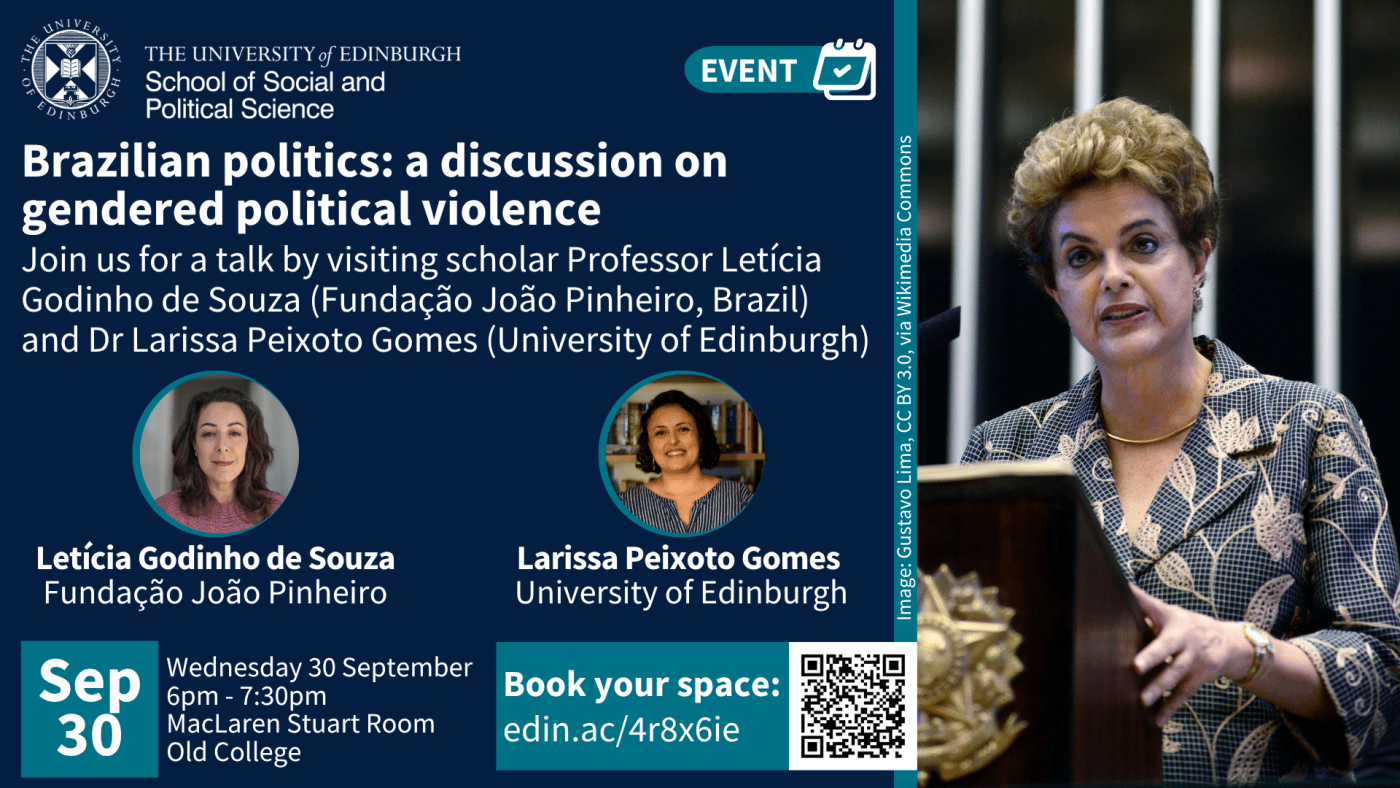
Gendered and racialised political violence: representation challenges in contemporary Brazil with Professor Letícia Godinho de Souza (Fundação João Pinheiro, Brazil)
The presentation is the result of the wide-ranging research project on violence suffered by politicians from minoritised groups in Brazil. It addresses the historical trajectory of women in Brazilian politics and their persistent under‑representation in parliaments, arguing that this process of exclusion is not merely a historical remnant, but an actively maintained phenomenon sustained by both visible and invisible mechanisms, including gender‑based political violence. Practical examples of such violence are explored and its impacts on women’s continued participation in political life are examined. Furthermore, I will discuss how the Brazilian state has been organised to confront this challenge.
10 years later – The coup against Dilma Rousseff
The presentation is a long-standing debate on the gendered aspects of the process that took place in 2016 – one that is still being discussed as a legal impeachment rather than a coup d’état. Through the arguments of symbolic representation and right-wing backlash, along with evidence from the last decade, it aims to show that Rousseff was the victim of a gendered coup due to her ‘outsider’ status from the homosocial networks that have formed over centuries in Brazil.
Chair Professor Sarah Childs, Personal Chair of Politics and Gender
Author Bios:
Letícia Godinho de Souza has been a professor at the Fundação João Pinheiro since 2008, in its undergraduate and Master’s programmes in Public Administration. She is the coordinator of the Master’s programme since 2021. She holds a Master’s degree (2005) and a PhD (2011) in Political Science from the Federal University of Minas Gerais (UFMG) and her main research interests are in the areas of gender and public security.
Larissa Peixoto Gomes is a research fellow at the University of Edinburgh, a member of the Edinburgh Open Research Initiative, and the Gender and Politics Research Group. She holds a Master’s degree (2010) and a PhD (2019) in Political Science from the Federal University of Minas Gerais (UFMG) and her main research interests are in the areas of electoral systems and the representation of marginalised groups.
This seminar is hosted by the Gender and Politics Research Group.