CRFR Seminar: Who Does What? The Gender of Ecological Living in a French Rural Area
Venue
Violet Laidlaw Room, Crystal Macmillan BuildingMedia
Image
Description
In this presentation, Mathilde Krähenbühl explores the gendered implications of ecological and alternative modes of living.
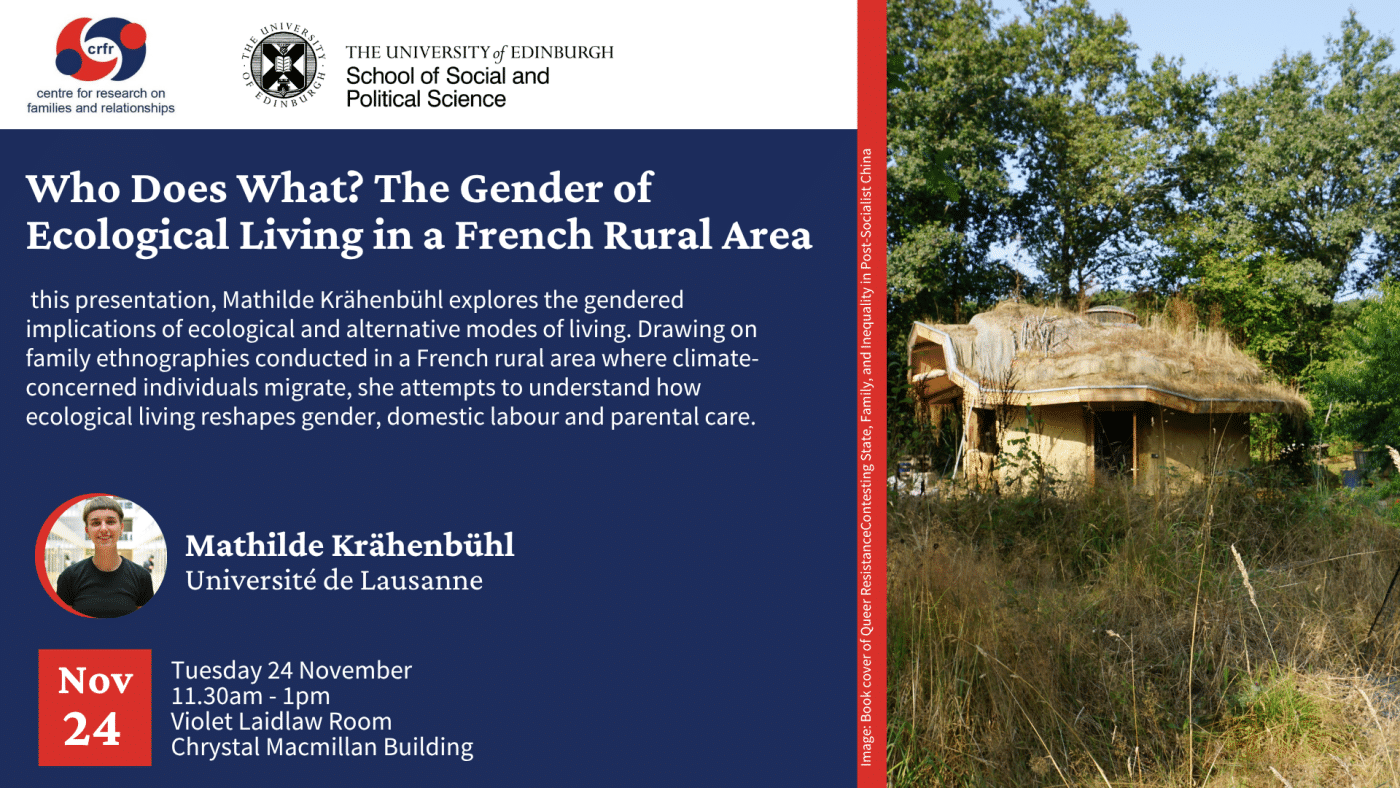
Although temperatures have broken all records in Central Europe, climatologists warn that last summer may have been “the coolest of the rest of our lives”. In this context of precarious futures, reproductive pathways, parenting and kinship are reshaped. To examine how climate-concerned individuals negotiate parenthood, I conducted an ethnography of a rural region of France where many people migrate to raise their children and build ecological ways of living. Inscribed in a longer history of ‘back-to-the-land’ movements, these migrations illustrate not only a quest for a safer environment but also a search for alternative futures.
Reducing their participation in labour market and economy, my interlocutors develop lifestyles where subsistence practices (farming, growing vegetables, bio-construction, etc.) and parenting are given a central role. In this presentation, I explore the gendered effects of these ways of life. From a feminist perspective, the domestic sphere is a key site where gender relations and power dynamics are produced and negotiated. Several research show that rural living and injunctions to “living green” tend to reinforce the gendered division of labour. Asking “who does what” is necessary to understand how ecological living reshapes gender, domestic labour and parental care. To address this question, I analyse materials collected during family ethnographies.
Short bio: Mathilde Krähenbühl is a visiting researcher at the University of Edinburgh. She is pursuing a PhD in Anthropology at the University of Lausanne (Switzerland), under the supervision of Geneviève Pruvost (Paris/EHESS) and Irene Maffi (Lausanne/UNIL). Through ethnographic research conducted in a rural region of France, she explores the interconnections between perceptions of environmental crises, ecological ways of living, and kin-making.